The Value of Freedom

Over the past month, I have gotten the chance to read such an inspirational novel, truly outlining through each characters role, how lucky we are to live in a society, with equality. While reading The Book of Negroes, written by award-winning author Lawrence Hill, he had the ability to draw me in with his unbelievable literature, that had me glued from the front cover to the last page. I followed the path that Hill paved, and in following this path, my critical thinking and depth in analyzing text and meanings advanced to a whole new level. Since I have viewed this novel in the Readers Response Theory and the Archetypal Literary Theory, I found looking at certain events, emotional meaning, and influencing characters, the most beneficial to my understanding.

While looking back and analyzing the whole novel in this theory, I was encouraged to think deeply about the story itself and make connections along the way, to further my knowledge. When viewing this novel through the Archetypal Literary Theory, I focused on any reoccurring themes, symbols, images, character types, etc. This allowed me as the reader to imagine what the author was thinking at the time of writing this novel. Common Archetypal, including The Hero, The Villain, and The Trickster, that the author incorporated, allowed me to further grasp each characters role, create an opinion and make better connections to the Archetypal Literary Theory.

As mentioned in my pervious blog post, specifically focusing on the second part of the novel, the main character Aminata Diallo fit the perfect archetype of being The Hero. This archetype was not crystal clear to me at the very beginning of her journey. She was the young, shy, eleven year old girl, who got stripped of her identity, in her home town of Bayo. Through every up and down from the beginning of the book till the very end, she overcame many obstacles that were put in front of her. Including surviving the great crossing, to being humiliated, bought, owned, enslaved, and raped, to learning how to read and write, making money for herself and striving for freedom. All doing so, while she lost the ones she leaned on the most. Every struggle to a little bit of happiness, brought Aminata to take on the role of being the hero, and being the woman she is today. Aminata describes to another character the hatred she did not hold against any white individual saying, “If I spent my time hating, my emotions would have been spent long ago, and I would be nothing more than an empty cowrie shell” (Hill. 464). At such a young age, fighting against anyone who challenged her, and reading through her perspective, gave me the insight of what I could not experience. She continued to prove and push through the hard time, relying on allies and the personality of different characters, making her fit The Hero Archetype.
While I have focused on Aminata’s Archetype, Hill used multiple different Archetypes to further explain in depth, each role, each character played.
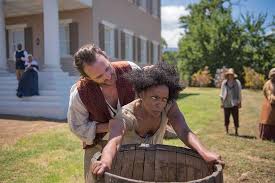
The character that takes on the role of being the villain is Robinson Appleby. He is the man who bought Aminata, when she was 11 years old. His main goal in the book was to show his power and authority over his “property”.

The character that took on the role of being the trickster, was Solomon Lindo. From the beginning, he displayed this aroma of kindness to Aminata. Later the true colours came out in court when Lindo stated, “And to arrange the sale of Mamadu, son of Meena. Said sale to be effected in Savannah, Georgia, on terms suitable to Robinson Appleby. Proceeds of sale of son to be divided, three quarters to Mr. Appleby and one quarter to Mr. Lindo” (Hill 309). Lindo had involvement in Aminata’s separation with her son, taking some of the profit.
Main Symbols

One of the symbols that throughout the book, they keep identifying Aminata with is the half moons on each cheek. Sam stated, “From the moons on your face, I suspect that your journey began long before Charles Town.” (Hill 247) This symbol connects her back to her home village in Bayo Africa and her religion/culture she practises.

Another symbol that was forced upon each slave as they got pushed off the ship, was the brand that they put above each negroes chest. The branding showed who they belonged to and stripped them of their freedom.
Work Cited
Google Search, Google, http://www.google.com/search?biw=1440&bih=772&tbm=isch&sa=1&ei=oiomXeqfIYO0sQX-7YHQDQ&q=slavery pictures&oq=slavery&gs_l=img.1.2.0l10.258086.260129..262151…0.0..0.105.645.6j2……0….1..gws-wiz-img…..0..0i67.PZjuDY-Bymg#imgrc=kMil7-3KNQXs6M:
“Lawrence Hill Author.” Lawrence Hill, http://www.lawrencehill.com/.
“The Book of Negroes.” The Book of Negroes | The Canadian Encyclopedia, http://www.thecanadianencyclopedia.ca/en/article/the-book-of-negroes.
Fisher, Max. “Read the Most Important Speech Nelson Mandela Ever Gave.” The Washington Post, WP Company, 5 Dec. 2013, http://www.washingtonpost.com/news/worldviews/wp/2013/12/05/read-the-most-important-speech-nelson-mandela-ever-gave/?noredirect=on&utm_term=.65e7d292029e.
Google Search, Google, http://www.google.com/search?q=ArchetypalView&source=lnms&tbm=isch&sa=X&ved=0ahUKEwjOw8j6l7jjAhUwc98KHVvYD68Q_AUIECgB&biw=1440&bih=772#imgrc=0yro2oQgEOyuPM:
Google Search, Google, http://www.google.com/search?biw=1440&bih=772&tbm=isch&sa=1&ei=sBstXYCuNoWwtQXM4IP4Dw&q=The book of negroes appleby&oq=The book of negroes appleby&gs_l=img.3…166306.169822..170073…1.0..0.98.1031.13……0….1..gws-wiz-img.YEOW0CDn8VY#imgrc=dApNOmfOVbAKTM:
Google Search, Google, http://www.google.com/search?biw=1440&bih=772&tbm=isch&sa=1&ei=sBstXYCuNoWwtQXM4IP4Dw&q=The book of negroes appleby&oq=The book of negroes appleby&gs_l=img.3…166306.169822..170073…1.0..0.98.1031.13……0….1..gws-wiz-img.YEOW0CDn8VY#imgrc=VQLkdVmHzj4nzM:
Google Search, Google, http://www.google.com/search?biw=1440&bih=772&tbm=isch&sa=1&ei=hh4tXc_jPIKAsQWZqp6oBw&q=The book of negroes solomon lindo&oq=The book of negroes solomon lindo&gs_l=img.3…74169.79052..79474…0.0..0.113.1609.16j2……0….1..gws-wiz-img.Bk1jeOs_s94#imgrc=K5WeiYqGjA6ylM:
Google Search, Google, http://www.google.com/search?biw=1440&bih=772&tbm=isch&sa=1&ei=1x4tXbLMH9GisAWJzb_wCg&q=The book of negroes aminata moons&oq=The book of negroes aminata moons&gs_l=img.3…261646.267580..267859…0.0..0.101.1105.13j1……0….1..gws-wiz-img.0ayJ5HePlWw#imgrc=rIdAVB1YUNWgXM:
Google Search, Google, http://www.google.com/search?biw=1440&bih=772&tbm=isch&sa=1&ei=1x4tXbLMH9GisAWJzb_wCg&q=The book of negroes aminata moons&oq=The book of negroes aminata moons&gs_l=img.3…261646.267580..267859…0.0..0.101.1105.13j1……0….1..gws-wiz-img.0ayJ5HePlWw#imgrc=RAmmyJTTEZlmiM:
“About Frith Luton.” FrithLutoncom, frithluton.com/articles/hero-archetype/.
“Villain: Definition and Examples.” Literary Terms, 16 Sept. 2017, literaryterms.net/villain/.
“The Trickster.” TV Tropes, tvtropes.org/pmwiki/pmwiki.php/Main/TheTrickster?from=Main.TricksterArchetype.
wikiHow. “How to Tell Whether the Moon Is Waxing or Waning.” WikiHow, WikiHow, 24 June 2019, http://www.wikihow.com/Tell-Whether-the-Moon-Is-Waxing-or-Waning.
Hill, Lawrence. Book of Negroes. HarperCollins Publishers, 2011.
 The Book of Negroes